Governments and the press, like Don Quixote, bravely battle enemies that exist only in their imagination.
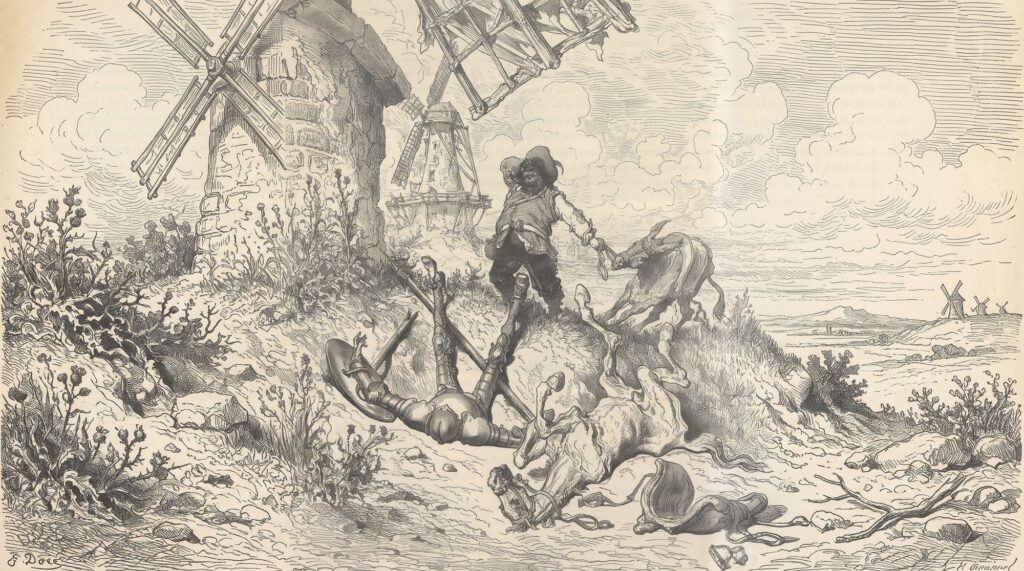
I suspect that Miguel de Cervantes, the great Spanish author, had he been born in this century, would have conceived Don Quixote as a legislator brimming with bills, or as some “expert” columnist in the Finance section of a major newspaper. Picture with me our bumbling hero, wielding his pen against the “oppressive market” or “speculative capital”. Should his usual bad luck hold, he would surely be born in a Latin American country and, without ever noticing, would have no doubt he was fighting giants as he charged the windmills that turn the economy. His great enemy? The dollar!
In truth, this much-personified market, which is neither evil nor good, is merely a multitude of people trying to survive rationally in a world that, by and large, insists on treating them as suspects.
Let us go deeper into the fantasy: faced with so much mistrust, it is only to be expected that this giant, with tiresome regularity, wakes up nervous. Especially when it is accused of being the villain of the novel.
What a curious coincidence that countries world-famous for their flair for soap operas, such as Brazil, Mexico, Turkey, Venezuela or Colombia, are also among the most skilled at casting the economy as the villain of a serial melodrama. Any of them would be the perfect setting for an updated adaptation of that masterpiece. Mostly because they love to follow the same old recipe, which never fails to end up smeared with the melodrama everyone has already watched countless times. For some reason, they believe it is worth watching again.
Look! Our political and economic news, more often than not, has the whole cast we need to honour Cervantes in this imaginative exercise: the misunderstood and, above all, the brave and morally convinced who are, nonetheless, completely mistaken.
According to the Profile of the Brazilian Journalist project (UFSC, RETIJ and SBPJOR)*, for example, most Brazilian journalists are on the left or centre-left (81%). This is probably one of the reasons for such hostility. I illustrate the point with the country that has the largest market within the group of soap-opera nations. This picture, however, has been exhaustively observed by many other bodies, in several countries.
We may read this figure as a reason why, since this majority would carry with it an education, intellectual traditions and beliefs about the world more grounded in hierarchical models of power, as tends to be the nature of collectivism. In other words, their views may ignore or reject one specific perception of things: that they can be decentralised and distributed in nature and in the way they work. Perhaps they see it this way because they judge this kind of arrangement too disorganised and chaotic. Therefore, unfair. In need of taming.
Consequently, they understand that the organisation of things usually comes from centralised structures. Which would suggest that certain kinds of order are always commanded by someone. A villain or a hero at the top of a pyramid-shaped ecosystem. And there, personified, would be our giant.
Under this hypothesis, when the dollar rises, the blame lies not with demand, nor with fiscal recklessness, nor with legal uncertainty: it lies with “the market”, that cruel invisible knight conspiring against the noble people of La Mancha.
As is well known, the market cannot be treated as an entity, much less as a character or a secret society. It is an ecosystem in dynamic equilibrium. A great bazaar of individual decisions, where millions of agents (people or institutions), each with their own interests and moods, adjust the price of things according to the information available. Trying to find a single, higher will in all of this is as delusional as blaming the wind for turning the mill.
Unfortunately, for those who prefer to see the world as a hierarchical structure of power, arguing from an understanding that allows for decentralisation is almost offensive. If no one is in charge, whom do we blame? And if there is no culprit, how do we write the headline?
The story gets more interesting once you realise that this confusion is useful. The press, whose financial health has historically depended on the biggest advertiser in its country, the government, found in the demonisation of the market an excellent rhetorical device.
Turning it into an external enemy is an elegant way of helping the authorities justify their mistakes. It is the perfect villain: faceless, it gives no interviews and files no lawsuits. And so every act of fiscal irresponsibility becomes resistance from “speculators”, every currency devaluation the fault of “the forces of Wall Street”. An entity as abstract as the Zeitgeist or so-called “public opinion”.
It is a textbook narrative: create the monster, attack it and, as a bonus, propose more state intervention in order to “protect the country” from the creature’s return. The cycle feeds itself with admirable efficiency. Don Quixote would be pleased! The imaginary dragon is slain every day and, the next day, rises again to justify one more adventure.
A market on life support
It is also true that certain markets do little to improve their own reputations. Repressed, over-regulated and monopolised, the supposed capitalism of certain regions, such as Latin America and the Mediterranean countries, looks more like an athlete training with half a lung. Few players, heavy concentration and even more bureaucracy. In such an interventionist environment, the market actually resembles a private club. A distorted version of the ecosystem. At this private cocktail party with its restricted guest list, the flows are dominated by a handful of giants, while the rest of the country watches from outside, grumbling about the greed of the big players. That is why these whales awaken paranoia with the intensity of Moby Dick. One can understand the anti-capitalist and “anti-business” sentiment in such environments, but let us take one novel at a time.
Meanwhile, in places like the United States, this so-called market is far less schizophrenic. Small wonder that capital ends up running there. A powerful and more homogeneous web of agents and exchanges. Millions of investors of every size, competing for every cent, make the system fluid, liquid, a set of “communicating vessels” and, consequently, healthier. Indeed, more democratic.
Most Brazilians, Turks, Greeks or Mexicans do not invest in shares, hold no corporate bonds and do not follow market indices*. To the average citizen, IBOV, BIST, ATHEX or BMV, their respective stock-exchange indices, sound more like the names of government departments than of indicators. And so the market becomes a distant concept and, in a way, one more superior and central body, something that exists on the evening news but not in real life.
In the American market, by contrast, the swings of the stock exchange move the national mood: retirement savings, pension funds and personal savings depend on them. A sharp contrast with places where short-term fluctuations in asset prices affect headlines more than pockets. Where there is no direct experience, narratives reign.
Giants everywhere: the national myth of the invisible enemy
“The market”, therefore, plays in some people’s imagination the same role that “imperialism” played in the 1960s and 1970s: it is the villain that justifies anything. It serves to explain inflation, unemployment, the strong dollar and even climate change, if need be. As a bonus, it gives the press and the government a common target, something that always helps them keep up good commercial and ideological relations with each other.
The market is the real hero
In the seventeenth century, shortly after the death of Miguel de Cervantes, Holland created the East and West India Companies (the first publicly traded companies in history, backed by thousands of individual shareholders). Thus the principle of financial decentralisation was already proving superior to the state monopolies of the Iberian crowns. While the Low Countries prospered under a model of dispersed capital and shared responsibility, Portugal and Spain, land of the decadent hidalgo Don Quixote, clung to their Houses of Trade (the Casa da Guiné, the Casa da Índia and de Angola and the Casa de Contratación in Seville), bureaucratic bodies, all rigidly controlled by the king, with state monopolies that stifled private initiative in that fruitful age of expanding international maritime trade.
The result today speaks for itself. While Holland was inventing the modern stock exchange and an almost republican model of governance in trade, the Iberian empires were drowning in colonial gold, yet ended up indebted and politically authoritarian. In short, decentralised capital produced wealth and freedom; centralised capital produced dependence and propaganda. Latin Americans, unfortunately, inherited more of the second tradition than of the first.
Ultimately, the market (in its most liquid, homogeneous and transparent form) is the purest expression of modern democracy and must in no way be mistaken for the villain of this novel. No assembly, plebiscite or parliament translates the collective will and sentiment as immediately as the rise and fall of an asset. Price is information! (Friedrich Hayek, “The Use of Knowledge in Society”, published in 1945 in the American Economic Review.) In a healthy market, every investor, however small, puts pressure on power with their own money, allocating or withdrawing their resources. The result appears in real time, without mediation, censorship or rhetoric. It is the universal suffrage of prices, at the service of the adventure of each and every knight in this story of ours. Let us not act like madmen!
A note on sources
The figures behind the argument above come from custody records and public surveys, and they measure different things in each country, so they serve to give an order of magnitude, not an exact comparison. In Brazil, B3 counted 5.7 million individual taxpayer IDs (CPFs) in equity and other variable-income products in the second quarter of 2026, a category that includes real-estate funds, ETFs and BDRs, not just shares. Anbima’s Raio X do Investidor survey shows that 36% of the population aged 16 or over invests in some financial product, but the 2023 edition indicated that shares were held by only 2% of the total population. In Turkey, MKK, the country’s central securities depository, recorded 6.4 million equity investors in April 2026, an unstable figure: according to Türkiye Today, it fell from 8.34 million in May 2024 to 6.53 million in June 2025. In Greece, Euronext Athens’s April 2026 report gives a monthly average of 34,328 active investors at the start of the year and a foreign share of 69.7% of total capitalisation. In Mexico, the 27.7 million accounts at brokerage firms, more than 96% of which belong to a single institution, measure digital accounts, not shareholders, which is why I do not convert them into a share of the population, not least because 74.1% of investment-fund assets, according to AMIB, are in debt funds.
Reference
MICK, Jacques; LIMA, Samuel (coords.). Perfil do jornalista brasileiro: características demográficas, políticas e do trabalho de quem informa o país. Florianópolis: Insular; Universidade Federal de Santa Catarina (UFSC), 2021. Available at: https://perfildojornalista.ufsc.br/. Accessed: 25 Oct. 2025.